Integrated Safety Assessment of TRIGA Pitesti Research Reactor by IAEA
Upon a request from the Romanian regulatory body (CNCAN) and the Institute for Nuclear Research, Pitesti, Romania (RATEN ICN), an Integrated Safety Assessment of Research Reactors (INSARR) mission was conducted from 30 September to 7 October 2025, to TRIGA Research Reactor.
The INSARR mission was requested to assist RATEN ICN on the first periodic safety review (PSR), aiming to prepare for licensing extension to 2035, and to enhance the ageing management of the facility. The objective of the mission was to review the safety of the reactor, reactor management, safety committee, management system, training and qualification, safety analysis, siting and protection from external events, operational limits and conditions (OLCs), conduct of operations, maintenance, ageing management, safety of the utilization programme and modifications, operational radiation protection and waste management, emergency planning, and decommissioning planning. The review was performed following the methodology established by the IAEA Guidelines for the Review of Research Reactor Safety, IAEA Services Series No. 25 (Rev.1).
The TRIGA reactor plays a significant role in scientific research, education, and the production of radioisotopes used in medicine and industry. The facility is not designed to generate electricity but rather to support experimental and applied nuclear science. Its continued operation is therefore important for maintaining Romania’s capabilities in nuclear research and training specialists in the field.
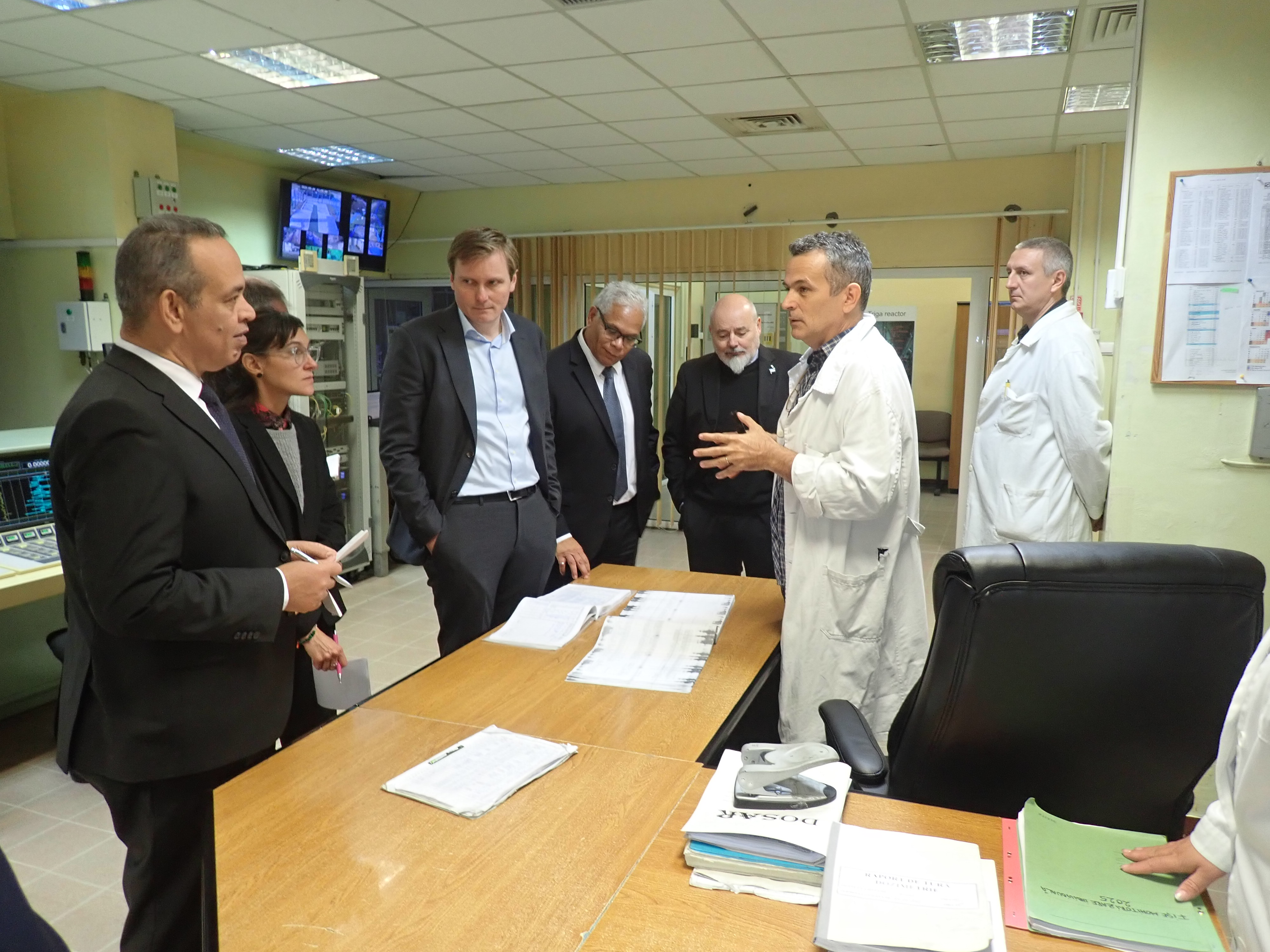
The INSARR mission acknowledged that the reactor has benefited from ongoing upgrades and improvements over time. These include modernization efforts and measures aimed at strengthening safety systems and operational practices. Also was noted that the facility demonstrates a commitment to maintain international safety standards, which is reflected also in the outcomes of several similar reviews in the past decades. However, the evaluation also highlighted the challenges associated with the reactor’s age. Having been in operation since beginning of 1980, the TRIGA Pitesti Research Reactor is now over 40 years old, which place it among a large number of aged research reactors worldwide. This raises important concerns related to the long-term integrity of systems, structures, and components. Maintaining a safety operation requires careful management of the above, including regular inspections, upgrades, and the implementation of aging management programs.
The IAEA emphasized the importance of continuing these efforts, particularly in areas such as safety culture, documentation, and long-term planning. While no major safety issues were reported, the recommendations suggest that further improvements are necessary before a final decision on lifetime extension can be made. This indicates that the process is ongoing and that extending the reactor’s operation will depend on Romania’s ability to address these technical considerations effectively.
In conclusion, the TRIGA Pitesti Research Reactor is well-maintained and valuable for research and education, but its advanced age requires sustained attention and investment. The IAEA’s role is crucial in providing an independent and expert assessment, helping to ensure that any decision regarding the reactor’s future is based on rigorous safety standards rather than solely on economic or strategic interests
Silviu Stanciu
RATEN ICN
silviu.stanciu@nuclear.ro