The Contribution of RATEN ICN to Material Testing within WP2 of the H2020 ECC-SMART Project
Currently, the foundation for Small Modular Reactor (SMR) technologies based on Generation IV (GEN IV) concepts is being established worldwide. Among the six most promising concepts under the Generation IV International Forum (GIF) there is the Supercritical Water-Cooled Reactor (SCWR). Given the rising interest in SMRs, the SCWR configuration has been scaled down to assess the feasibility of a Supercritical Water-Cooled Small Modular Reactor (SCW-SMR)
In this context, the ECC SMART project brought together institutes from China, Canada, and Europe to assess the feasibility and safety of SCW-SMRs. The primary objectives were to define design requirements, develop pre-licensing studies and safety demonstration guidelines, and identify key licensing obstacles while proposing strategies to address them. The project involved 20 partners worldwide and was divided into four technical and two administrative work packages.
The RATEN ICN team was involved in theWork Package 2 „Materials testing“ and focused on testing of two commercial candidate materials (310S stainless steel and Alloy 800H) with geometry as close as possible to reactor-relevant configurations of future fuel cladding. The goal was to understand their corrosion behavior under SCW conditions. The objectives defined for WP2 were: obtaining a deep and complete understanding of corrosion behaviour of the most promising materials candidate to claddings of SCW SMR; carry out long term exposure as well as the elctrochemical measurements under SCW conditions, assess the corrosion behaviour of pre irradiated materials under SCW conditions; provide the obtained results to support the qualification procedure for SCWR SMR selected materials
RATEN ICN conducted out-of-pile, long-term oxidation tests (up to 7,000 h) in static autoclaves. Experimental parameters were maintained at a pressure of 25 MPa and temperatures of 380 °C and 500 °C representing the pseudocritical point of water respectively the expected outlet temperature of the SCW-SMR concept. The solution used was demineralized water with a controlled dissolved oxygen concentration of 150 ppb.
Prior to testing, specimens were characterized microstructurally, including surface condition and microhardness. Cross-sectional microhardness tests revealed that the outer diameter of the tubes exhibited higher hardness than the inner diameter, particularly in the 310S specimens. These findings, along with subsequent microstructural analyses, correlated closely with results from CVR (Czech Republic).
Four laboratories—JRC, CNL, RATEN, and SJTU—completed these long-term tests. Long-term corrosion tests were the most important objective of the WP2 activities. Only long-term tests can really verify the long-term corrosion resistance of selected materials under conditions simulating those expected in an SCWR. Such tests are also essential for the development of reliable prediction tools.
All partners confirmed very low corrosion rates (based on weight gain) for both materials at 1,000 h. For the full 7,000 h exposure at 500 °C, JRC, CNL and RATEN, produced nearly identical weight gain results for AISI 310S, following near-cubic kinetics. This consistency validates the reliability of the testing protocols. The oxide thickness results for specimens exposed to 500 °C SCW showed much less scatter compared to those that were measured in 380 °C SCW.
|
|
|
|
|
Fig. 1: Prediction of corrosion behaviour (oxide thickness growth due to corrosion in SCW at 500 °C) of (A) Alloy 800H and (B) AISI 310S specimens by JRC during the fuel-cycle lifetime up to 30,600 h. (© ECC SMART project Grant Agreement Number: 945234, H2020 – NFRP-2019-2020)
|
Fig. 2: Prediction of corrosion behaviour (oxide thickness growth due to corrosion in SCW at 500 °C) of (A) Alloy 800H and (B) AISI 310S specimens by CNL during the fuel-cycle lifetime up to 30,600 h. (© ECC SMART project Grant Agreement Number: 945234, H2020 – NFRP-2019-2020)
|
Fig. 3: Prediction of corrosion behaviour (oxide thickness growth due to corrosion in SCW at 500 °C) of (A) Alloy 800H and (B) AISI 310S specimens by RATEN during the fuel-cycle lifetime up to 30,600 h. (© ECC SMART project Grant Agreement Number: 945234, H2020 – NFRP-2019-2020)
|
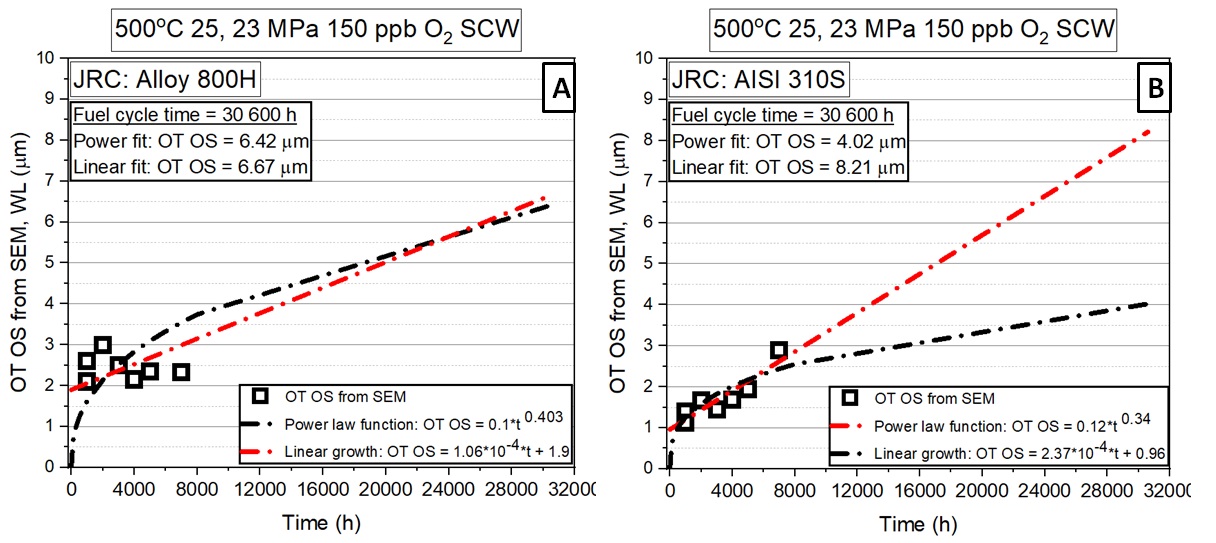
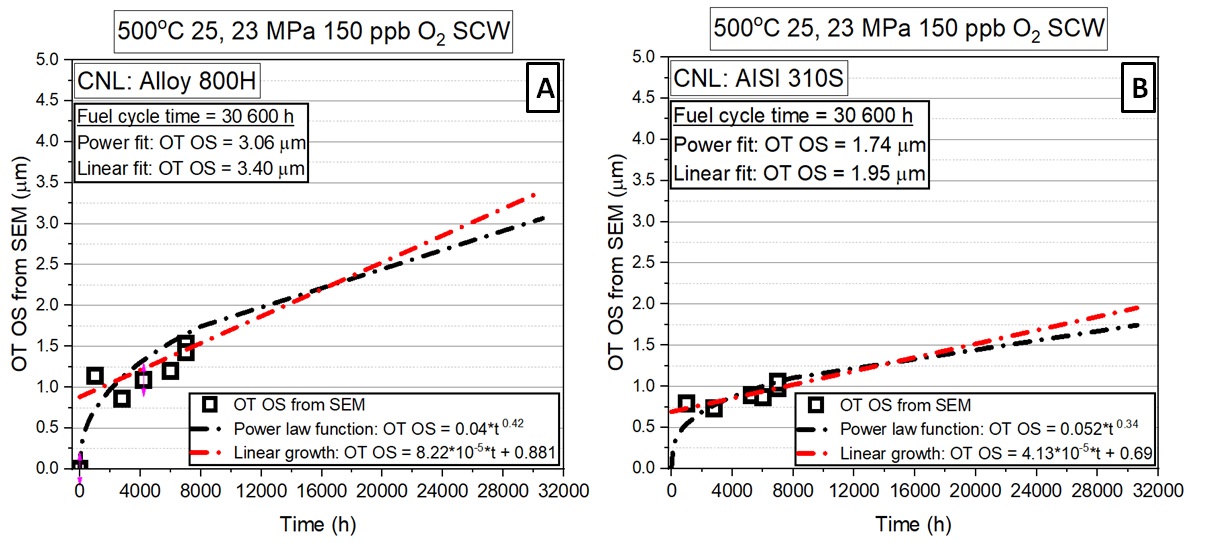
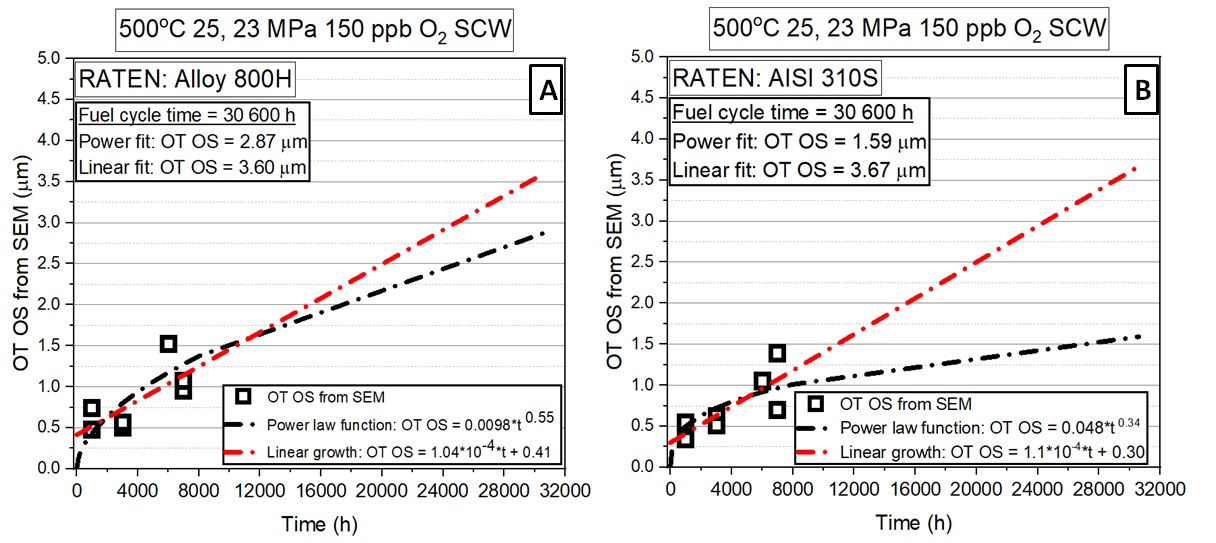
The 7,000 h tests confirmed that both Alloy 800H and 310S exhibit stable oxidation behavior; extrapolated oxide thicknesses remained within acceptable limits even after a projected 30,600 h of service.
Gravimetric weight change and weight loss analyses were supplemented by detailed surface and cross-sectional characterizations using SEM, SEM-EDS, and XRD. The resulting corrosion rates and oxide thicknesses served as a basis for predicting the alloy's long-term durability through extrapolation to the full fuel cycle (30,600 h). OM and SEM observations confirmed that oxide layers remained below 2 μm after 7,000 h of exposure at 500 °C/25 MPa.
All project data were integrated into the MATDB engineering database, managed by the JRC via the European Commission’s ODIN network.
Dr. Ing. Manuela Fulger
RATEN ICN
manuela.fulger@nuclear.ro