DEC Safety Assessment Issues & Related R&D Activities
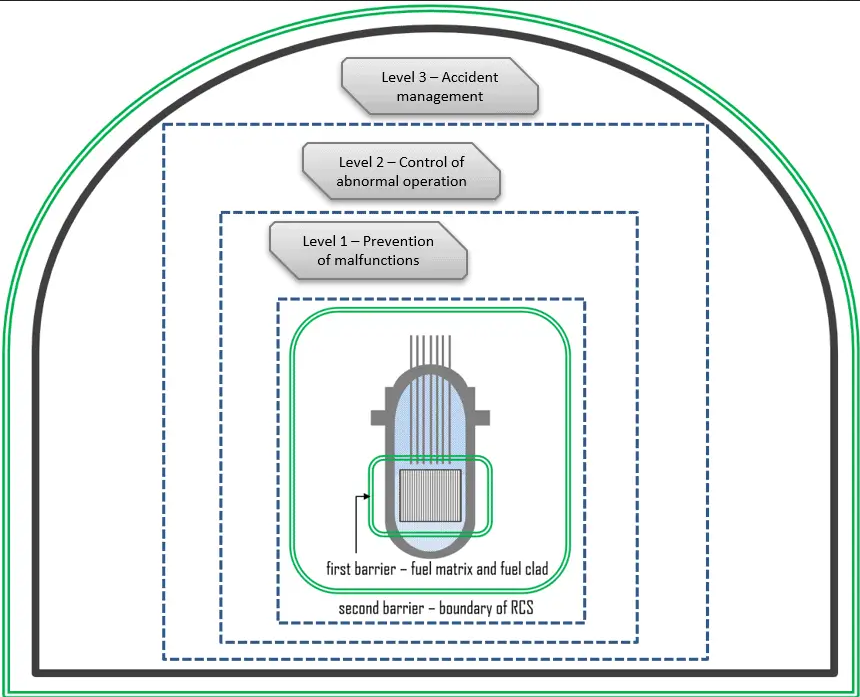 Design Extension Conditions (DEC) analyses are generally carried out to assess the degree to which the Nuclear Power Plants (NPPs) design can withstand challenging events that were not considered in the Design Basis Accident DBA scenarios [1], [2]. The objective is to get more confidence in the design robustness and to, eventually, identify hardware improvements and/or procedural measures to prevent accident progression towards severe conditions. These issues have introduced new challenges for Licensees, in terms of developing innovative approaches, identifying DEC events and related safety criteria, and for the Safety Authorities, in terms of building up the expertise needed for the approval of the DEC licensing issues.
DEC safety assessments were carried out by the Belgian Licensee for the operating NPPs by using innovative methodologies and advanced tools. As an outcome, design improvements and operator actions were identified and implemented accordingly.
On the other hand, the Belgian TSO Bel V developed and implemented a proactive R&D program that addresses DEC-A related topics that allow enhancing the overall knowledge related to DEC phenomenology and licensing aspects. For these purposes, targeted participations in several NEA projects and working groups as well as in some EURATOM projects were considered.
In this context, Bel V participated actively in several NEA thermal-hydraulic experimental projects as the ETHARINUS and ATLAS projects [3], [4], where a series of DEC-A scenarios including multiple SGTR induced by a SLB, SBLOCA with ECCS failure, asymmetric cooldown and boron dilution topics were carried out. Bel V participated also in the WGAMA/WGFS working group related to the redaction of a state-of-the-art report concerning the DEC-A practices in operating nuclear power plants [5]. Similarly, Bel V took part in the EURATOM R2CA project [6] addressing innovative methodologies to reduce radiological consequences following DBA and DEC-A LOCA and SGTR scenarios.
Besides the benefit related to the build-up of the expertise dealing with the DEC-A issues, adequate use and assessment of computer tool’s capabilities dealing with phenomena occurring during the DEC-A scenarios are also considered.
In this matter, Bel V was among the organizers of the analytical workshops planned in the framework of the OECD/NEA ETHARINUS and ATLAS projects and was among the participants of two International Standard Problems (ISPs) based on experiments carried out in the PKL and COAL test facilities [7], [8].
Within these frameworks, Bel V published several deliverables/papers (see Table 1) dealing with the use of advanced CATHARE code capabilities in simulating DEC-A scenarios where complex natural circulation phenomena and passive system performances were addressed.
1. CONCLUSIVE REMARKS
DEC safety assessments were carried out by the Belgian Licensee for the operating NPPs by using innovative methodologies and advanced tools. Besides, Bel V has established an R&D program with the purpose to gather the necessary knowledge and competences that allow effective evaluation of the Licensee’s DEC safety assessments. This R&D program was recently revisited with the aim of getting a more comprehensive assessment of the challenges related to the DEC topics and extending the scope to include issues related to passive systems and SMR’s design features.
Table 1 – Main outcomes of the DEC-A R&D activities.
| Framework/Project | Paper/ Report Title |
|---|---|
| EURATOM R2CA |
|
| OECD/NEA ETHARINUS |
|
| OECD/NEA ATLAS3 |
|
| WGAMA Working Groups |
|
| WGAMA/WGFS Working Group |
|
ACRONYMS
DBA: Design Basis Accident
DEC: Design Extension Conditions
NPP: Nuclear Power Plant
R&D: Research & Development
LOCA: Loss of Coolant Accident
SB: Small Break
SGTR: Steam Generator Tube Rupture
SLB: Steam Line Break
TSO: Technical Safety Organization
2. REFERENCES
[1] WENRA/RHWG Report: WENRA Safety Reference Levels for Existing Reactors, 2020.
[2] IAEA (2019c), ‘SSG-2: Deterministic Safety Analysis for Nuclear Power Plants’, Rev. 1, Specific Safety Guide, IAEA, Vienna, 2019.
[3] OECD/NEA/ETHARINUS project: https://www.oecd-nea.org/jcms/pl_59465/experimental-thermal-hydraulics-….
[4] OECD/NEA/ATLAS project: https://www.oecd-nea.org/jcms/pl_24812/advanced-thermal-hydraulic-test-….
[5] Analyses of Design Extension Condition without Significant Fuel Degradation (DEC-A) for Operating Nuclear Power Plants, A CSNI WGAMA and WGFS Status Report. NEA/CSNI/R(2025)xx.
[6] EURATOM R2CA Project: https://r2ca-h2020.eu/index.html.dd
[7] ISP52: https://www.oecd-nea.org/jcms/pl_89029/wgama-isp-52.
[8] ISP53: https://www.oecd-nea.org/jcms/pl_92672/wgama-isp-53
Stéphane Palmaerts
BelV
Stephane.palmaerts@belv.com